THE FILMMAKER
CHRIS SPICE
SOUTHAMPTON, HAMPSHIRE, UK
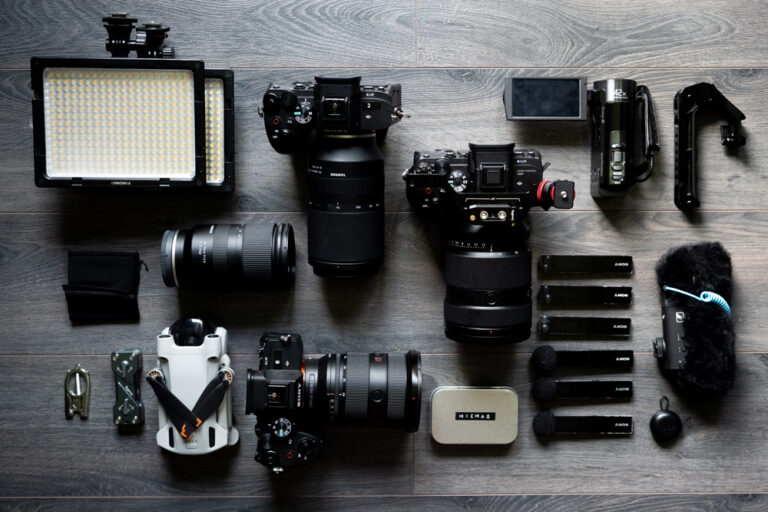
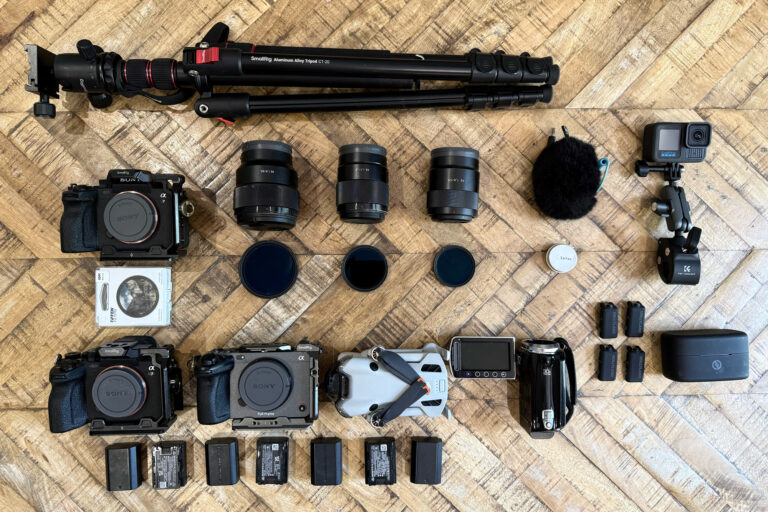
I’m far from a minimalist, and I do love a new bit of tech, but ultimately my gear bag has been designed for the smoothest possible operation on the day without compromising quality. I always have the exact focal lengths I need, I’m always ready to capture anything, my audio is ready to go in seconds, and I’m travelling light enough that setup and takedown are super easy.
In one wedding, I try to incorporate cinematic gimbal shots, fast-paced running handheld bits, and no-compromise ceremony and speeches coverage, which is why I have to be prepared in an instant to go from handheld candid shooting to cinematic sunset goodness. That’s why the Sony 28-70mm f2 GM has been a perfect all-rounder lens for me and has now become the lens I shoot 90% of my footage with.
Moments and enjoyment matter more to me than the perfect frame. I don’t tend to spend time framing up and picking focal lengths, so the zoom has been perfect for me.
This combination has been on a huge journey over the years. I used to shoot most of the day on the Sony 50mm f1.4 GM for the incredible fall-off and bokeh, but can you really say you’re ready to capture any moment in the best possible way if you’re on a 50mm all day?
I used to use Tascam recorders and lavaliers for every microphone, but then the mic-up process became tedious, and I never use them if the venue has a house mic anyway. Now I just use Hollyland microphones, which take a second to put on.
I chose Sony because that’s what I’ve known since the A7S II back in 2017, but I’ve stuck with Sony because of the reliability in autofocus, overheating performance, and the sheer number of lenses available.
Gear matters. It’s something I don’t think is preached enough. It matters because it should fit seamlessly into your workflow, you should enjoy using it, and it should allow you to capture in the way you want to capture. We all know the end result is often similar with how great cameras are these days, but it’s the experience for both myself and the couple that matters.
A-CAM
SONY A7 V
SONY 28-70MM F2 GM
The Sony A7 V is the newest addition to my kit bag, and it has changed a lot for me. S-Log3 for excellent dynamic range, 10-bit colour for easy colour grading, near-perfect autofocus, and reliability are things we’ve had in Sony cameras for a while, but the Sony A7 V has added a couple of clutch features for me.
Crop mode is back, so I can now crop into APS-C mode at any point, which gives me a 1.5x crop. This allows me to reach over 100mm with the Sony 28-70mm f2 GM or turn a prime into a zoom. When my goal is flexibility, this feature is incredible.
Dynamic stabilisation crops by about 1.3x but takes the stabilisation to the next level, meaning I’ve mostly left the gimbal gathering dust since I bought the Sony A7 V.
I genuinely think the Sony A7 V is a better option than the Sony A7S III or FX3 at the time of writing.
B-CAM
SONY A7S III
SECOND CAMERA
It’s crazy that this legendary camera has become my B-Cam, but the A7 V really is that good. The Sony A7S III is an absolute workhorse, and you could shoot weddings for the rest of your life with this camera quite easily.
I chose the Sony A7S III over the FX3 when I bought it because I prefer having a viewfinder. On a sunny day, I use the viewfinder quite a bit because the screens aren’t always bright enough.
I think people will be using the A7S III for years to come.
C-CAM
SONY A7C II
THIRD CAMERA
For all the times I say we should love the gear we use, I really don’t enjoy using this camera. On paper, it has most of the features of the cameras above, except it is cropped in 50p, but it just doesn’t feel the same to use.
I use the analogue stick quite a lot on the other cameras, but this one doesn’t have one. It also has fewer custom buttons, and for some reason the colours never quite match the other cameras.
I use it as a third camera, which essentially means it only comes out for the ceremony and speeches when I’m shooting solo.
The main reason I keep it is its size. It’s smaller than the others, which makes it a great personal camera for holidays when I want something more than my Fuji.
CAMCORDER
SONY FDR-AX53
GUEST CAMCORDER
My secret weapon. This camcorder has been one of the best things I’ve added to my business in the last couple of years.
I give it to a bridesmaid in the morning, and from there they can keep it all day or hand it around to other guests. I never direct them, never shoot with it myself, and just leave them to it.
It’s actually a modern camera, so it looks and sounds really good, but for the nostalgia factor I apply a light VHS effect in post.
LENSES
SONY 28-70MM F2 GM
PRIMARY A-CAM LENS
The Sony 28-70mm f2 GM is glued to my A-Cam and honestly feels like a cheat code for wedding videography, which is why it’s so popular at the moment.
28mm is wide enough to capture establishing shots and full-body shots where there’s space, and 70mm is tight enough for candids if people are slightly camera-shy, or for larger ceremony and speeches spaces.
Throughout the day, I use my Sony A7 V and the Sony 28-70mm f2 GM handheld, then switch to the gimbal, which is always balanced for this setup, when I really need a sweeping shot or something that requires smooth movement.
Switching to zooms isn’t easy. You almost have to train yourself not to keep readjusting the zoom. I usually reset it to 50mm after a shot, so that becomes my default focal length, and then I adjust from there.
I mentioned the dynamic stabilisation on the Sony A7 V, which is great with this lens. The 1.3x crop means I can set the lens to around 35mm, turn on dynamic stabilisation, and get a super-smooth 50mm confetti shot handheld.
TAMRON 35-150MM F2-2.8
CEREMONY & SPEECHES LENS
I originally bought this as an all-round lens before the 28-70mm was released and used it for a while, but honestly, the weight made it cumbersome, and Sony stabilisation isn’t as good with third-party lenses.
That being said, the lens itself looks incredible, has a great range, and will always find its way into the kit bag.
It is now used as my “back of the aisle tight” lens for ceremonies and as the main angle for speeches, so I can sit at the back of the room and shoot past people.
SONY 50MM F1.4 GM
CREATIVE PRIME
This lens will always have a place in the bag. While it gets used less now that I have the 28-70mm, there’s something about it that makes everything look so smooth and dreamy.
It works perfectly with Sony stabilisation, so it is really easy to shoot handheld.
I’ll often put it on my B-Cam so I’m ready to shoot candids with it at any time, or if the photographer is dragging out the couple shoot and I’ve had enough, I’ll pull this out and get creative.
SONY 85MM F1.8
SECOND-PASS CANDIDS
This is a lens I’ve owned three times because I can never decide how I feel about it. The footage looks great and it’s a super-cheap lens, but it’s niche enough that it rarely comes out.
Again, I don’t think you can call yourself reactive to moments if the Sony 85mm f1.8 is on your main camera, so I save it for a second walk around during the candids or evening.
If I’ve already got plenty of candids, I’ll have another walk around with the Sony 85mm f1.8 and get a bit more creative on a second pass.
The Sony 85mm f1.8 is also great for shots during the wedding breakfast. Guests at tables can look quite messy, so the compression is really helpful.
SONY 35MM F1.4 GM
WIDE CEREMONY BACKUP
The Sony 35mm f1.4 GM is the least-used lens in my kit. It used to sit alongside my 50mm, with one camera on each hip, but it hasn’t been used like this since the 28-70mm came onto the scene.
The Sony 35mm f1.4 GM is now a backup lens for tight ceremony spaces where my B-Cam needs to be wider than 50mm.
DRONE
DJI MINI 4 PRO
COMPACT DRONE
I think there’s the type of drone user who loves to milk the shots and capture everything with the drone, and then there’s the type who just pops it up for the venue shot or maybe during reception drinks. I’m the latter, so the DJI Mini 4 Pro is more than enough for me.
The ability to shoot D-Log means I can roughly match the footage with my Sony cameras, and it looks great.
The range is epic, and because the DJI Mini 4 Pro is so small, I can carry it around everywhere in my sling in case I see something I need to pop it up for.
AUDIO
TASCAM DR-10L
GROOM CEREMONY MICROPHONE
I used to have a few of these and exclusively used them for all audio. They’re some of the best pieces of kit I’ve used.
They’re not 32-bit float, but they have a limiter that stops the audio from peaking, and the auto mode is absolutely on point for audio levels.
Because the lavalier microphone is omnidirectional, it captures the bride perfectly during the ceremony when you put it on the groom.
I’d love to use only Hollyland microphones, but they just don’t capture the bride as well in this situation, so the Tascam is exclusively used for the groom microphone during the ceremony.
HOLLYLAND LARK MAX 2
CEREMONY & SPEECHES AUDIO
The Hollyland LARK MAX 2 is the newest addition to my audio kit, and the Hollyland system has honestly been a game-changer for me.
For context, I really don’t like the TX660 audio, but I loved the idea of quickly clipping something onto each speaker, so I previously used DJI microphones.
They’re great, but they’re thick and a little heavier, so they can weigh down shirts or dresses.
The Hollyland microphones record internally, have 32-bit float audio so they don’t peak, have a super-strong clip, and can use a magnetic mount to hide them.
I can even attach a lavalier microphone to the transmitters if needed.
If you’re concerned about monitoring them, I simply attach the receiver to the top of my camera so I can keep an eye on whether they’re recording.
MICMAG
MAGNETIC MICROPHONE MOUNTS
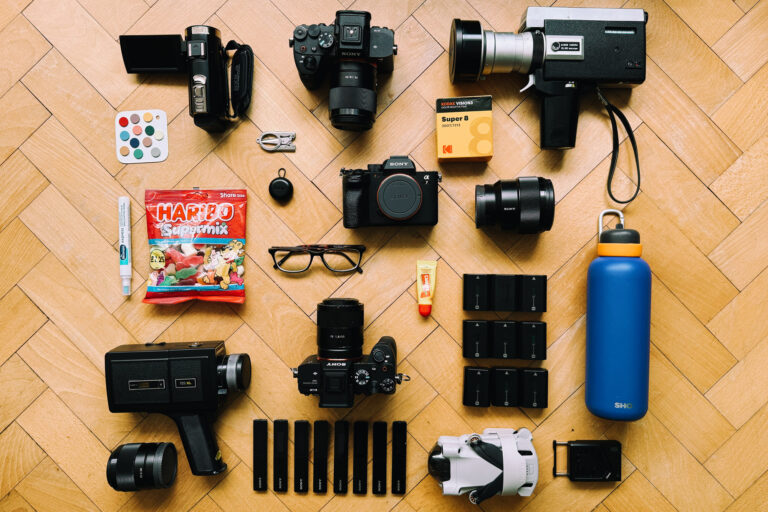
I had to include an honourable mention for MicMag, who provide the coloured, black, and white magnets you can see in the photo.
Using these magnets to colour-match a bridesmaid dress for a ceremony reading, or to mic up a bride with the white MicMag, has been brilliant, and I’ve genuinely received some great comments about them too.
GIMBAL
DJI RS 3 PRO
CAMERA STABILISER
It carries anything I throw at it, but it’s heavy and annoying at times. There’s not much more to say about a gimbal.
TRIPODS
ULANZI TRIPOD / LIGHT STAND
QTY: 2 • DUAL-PURPOSE SUPPORT
A super-tall tripod and light-stand hybrid that I use for both purposes to save room in my kit bag.
I use two of these during the day as tripods, and they become light stands in the evening.
PEAK DESIGN TRAVEL TRIPOD
carbon TRAVEL TRIPOD
An overpriced tripod that is actually really good. I’m not sure I’d recommend it with the number of options available now, but it’s lightweight, really stable, and takes seconds to set up, so what more could you want?
LIGHTING
ZHIYUN MOLUS X60
DANCE-FLOOR LIGHTING
I’m currently going back and forth over whether I’m going to continue using lights for the dance floor, but overall, I prefer the look with lights.
Not being at the mercy of terrible DJ lights or venue uplighting makes a difference, and a little flare and hair light adds to the drama of a dance floor.
I use these X60 lights because they’re super small, mostly only need around 10% power, and can be powered by a power bank, so I don’t need large NP-F batteries.
INIU 100w USB-C POWER BANKS
to power the Molus x60
I use 25,000mAh power banks with 100W cables to power the lights.
You can buy Zhiyun batteries that attach directly to the light, but the power banks last longer.
I wrap them around the bottom of the light stand, so they also act as a useful weight and help balance the centre of gravity.